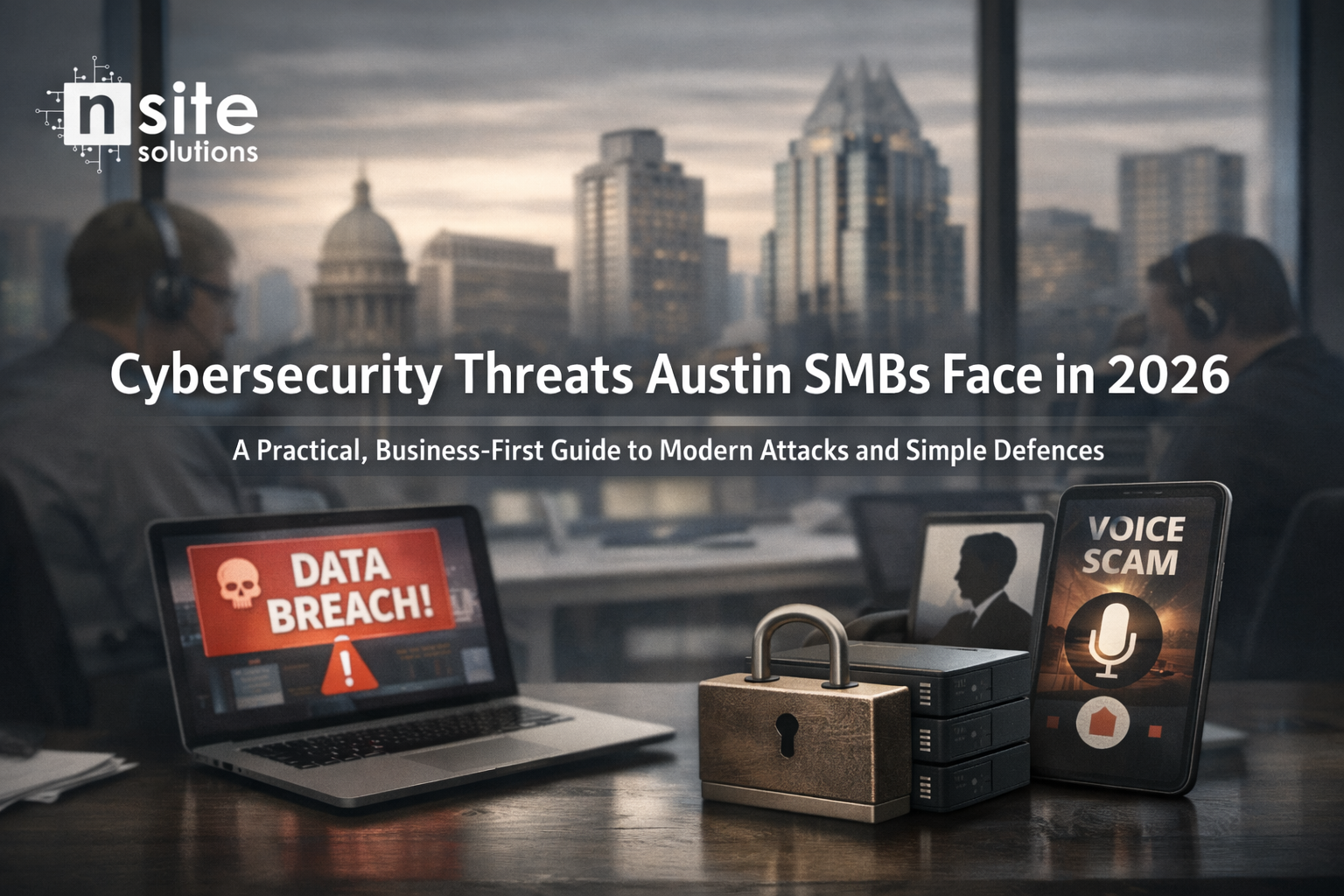
A Practical, Business-First Guide to Modern Attacks and Simple Defences
The Evolving Digital Landscape for Austin Small Businesses
Austin small businesses move fast. You adopt new tools quickly, you work with bigger partners, and you cannot afford downtime. That combination also makes SMBs a target: valuable data, lean security budgets, and busy teams.
In 2026, the biggest shift is precision. Attackers use AI to write believable messages, mimic real people, and time scams for your busiest moments.
The cost of getting it wrong can be brutal. IBM and the Ponemon Institute report a global average data breach cost of USD 4.44 million, and a United States average of USD 10.22 million.
Below are the top cybersecurity threats Austin SMBs face in 2026, plus the defensive moves that reduce risk without overcomplicating IT.
AI-Driven Social Engineering And Hyper-Personalised Phishing
Phishing is no longer a messy, obviously fake email. AI lets attackers write clean, convincing messages that match your industry and your internal language. They can pull details from LinkedIn, your website, press releases, job posts, and supplier directories to make the message feel inside the business.
The FBI has warned that cybercriminals are using AI to increase the speed, scale, and believability of phishing and social engineering, including voice and video cloning.
What it looks like for an Austin SMB:
- A payroll update request that references a real employee name and a real pay period
- A fake Microsoft 365 or QuickBooks sign-in page sent right when you are busy
- A vendor payment change request that matches the format of your normal invoices
Deepfake Audio and Executive Impersonation
Voice cloning is the upgrade to classic business email compromise. Instead of a suspicious email, your accounts payable person gets a quick call that sounds like the owner, the CFO, or a project manager. The request is usually urgent and framed as confidential.
You do not need to fear the technology as much as the process gap. If your team has a clear verification rule for money movement and sensitive access requests, deepfakes become far less effective.
Simple controls that work:
– Require out-of-band verification for any new payment destination (call a known number, not the number in the message)
– Set a no exceptions approval threshold for wire transfers and ACH changes
– Use a short internal code phrase for urgent finance requests (and change it periodically)
Ransomware: Encryption Plus Data Theft
Modern ransomware is not just about locking your files. Many groups steal data first and then apply pressure by threatening to leak it. This approach is widely referred to as double extortion.
For SMBs, the impact is usually a mix of downtime, recovery costs, and customer trust damage, especially if data is exposed.
Ransomware also hits small organisations disproportionately. Verizon’s 2025 DBIR SMB Snapshot reports ransomware was present in 88% of SMB breach cases analysed, compared with 39% in larger organisations.
Supply Chain Risk in a SaaS-Heavy World
If your business runs on cloud apps, your security posture is only as strong as your access controls and your vendor ecosystem. Attackers love third-party compromise because one successful breach can unlock many downstream victims.
Common SMB exposure points:
- Shared admin credentials for Microsoft 365, Google Workspace, or accounting tools
- Over-permissioned SaaS integrations (API keys that never expire, broad scopes)
- IT vendors with privileged access across many clients
The best response is not to abandon SaaS. It is to treat identity and access as the new perimeter: strong MFA, conditional access, and regular reviews of who and what can connect to your core systems.
Hybrid Work, Endpoints, and Smart Devices
Hybrid work spreads your environment across the office, home networks, and mobile devices. At the same time, smart devices keep creeping onto business networks: cameras, TVs, access systems, printers, and conference room gear.
Most SMB incidents still start with something basic: a compromised password, an unpatched device, or a user approving a fake login prompt.
That is why practical endpoint controls matter:
- Managed patching for operating systems, browsers, and common apps
- Endpoint protection that includes behavioural detection, not just signatures
- Separate guest and IoT networks so a compromised device does not expose your core systems
Compliance And Risk – Texas Privacy Rules Matter
Even if you are not a regulated healthcare or financial firm, you still have obligations when you collect personal data. Texas’ Data Privacy and Security Act (TDPSA) generally took effect July 1, 2024, with a delayed effective date for certain authorised-agent provisions. The law is enforced by the Texas Attorney General, includes a 30-day cure period after notice, and can carry civil penalties up to USD 7,500 per violation. Source: Troutman Pepper Locke summary
The takeaway – know what data you store, where it lives, who can access it, and how fast you can respond if something goes wrong.
A Practical Defence Plan For Austin SMBs
You do not need an enterprise SOC to be far safer than the average target. You need a small set of controls, consistently applied, and verified.
Start with these five moves:
- Lock down identity: MFA everywhere, especially email and finance systems. NIST recommends phishing-resistant MFA because password compromise and social engineering are major ransomware entry points.
- Backups you can actually restore: keep an offline or immutable copy, and test restores on a schedule.
- Patch management: automate updates for operating systems and the software your team uses every day.
- Email protection and training: reduce risky messages before they hit inboxes, and train staff to verify urgent requests.
- Segmentation and least privilege: limit admin rights and isolate critical systems so one compromise does not spread.
A smart next step is to validate your current posture with an assessment and a realistic remediation plan you can execute.
If you want help building a security plan that fits your team and your risk profile, start with Nsite’s IT Security Services and Cybersecurity Pen Test offerings, then talk with us about a phased rollout.
Ready to reduce risk without overcomplicating IT? Explore IT Security Services or schedule a Cybersecurity Pen Test. If you would rather talk first, contact Nsite here and we will help you map the next best steps.
FAQ’s About Cybersecurity Threats For Austin SMBs
How can I protect my business from AI phishing and voice cloning scams?
Set a verification rule for money movement and sensitive access: confirm requests through a known channel (like calling a saved number) and require two-person approval for new payment destinations. Pair that process with MFA and regular training so staff know what urgent social engineering looks like.
What is the biggest cybersecurity risk for most small businesses?
For most SMBs, identity compromise is the starting point: a stolen password, a successful phishing login, or an exposed admin account. Strong MFA, least-privilege access, and email protection typically reduce the highest-risk scenarios fastest.
Do backups stop ransomware?
Backups do not prevent ransomware, but they can dramatically improve recovery. The key is keeping an offline or immutable backup and testing restores. If backups are online and writable, ransomware can encrypt them too.
Why are SMBs hit so hard by ransomware?
Small teams often have less monitoring and fewer layers of defence, so attackers can move faster once they get in. Verizon’s DBIR SMB Snapshot also shows ransomware is present in a high share of SMB breach cases.
Does the Texas Data Privacy and Security Act apply to my company?
It can. TDPSA generally covers businesses that do business in Texas or offer products or services consumed by Texas residents, and that process personal data, with certain exemptions. If you collect customer or employee data, confirm what you hold and whether TDPSA obligations apply.
When should we consider a penetration test?
Pen testing is useful when you want a clear, prioritised view of exploitable weaknesses and what to fix first. Many businesses run a pen test annually, after major system changes, or when cyber insurance and compliance requirements demand evidence of testing.