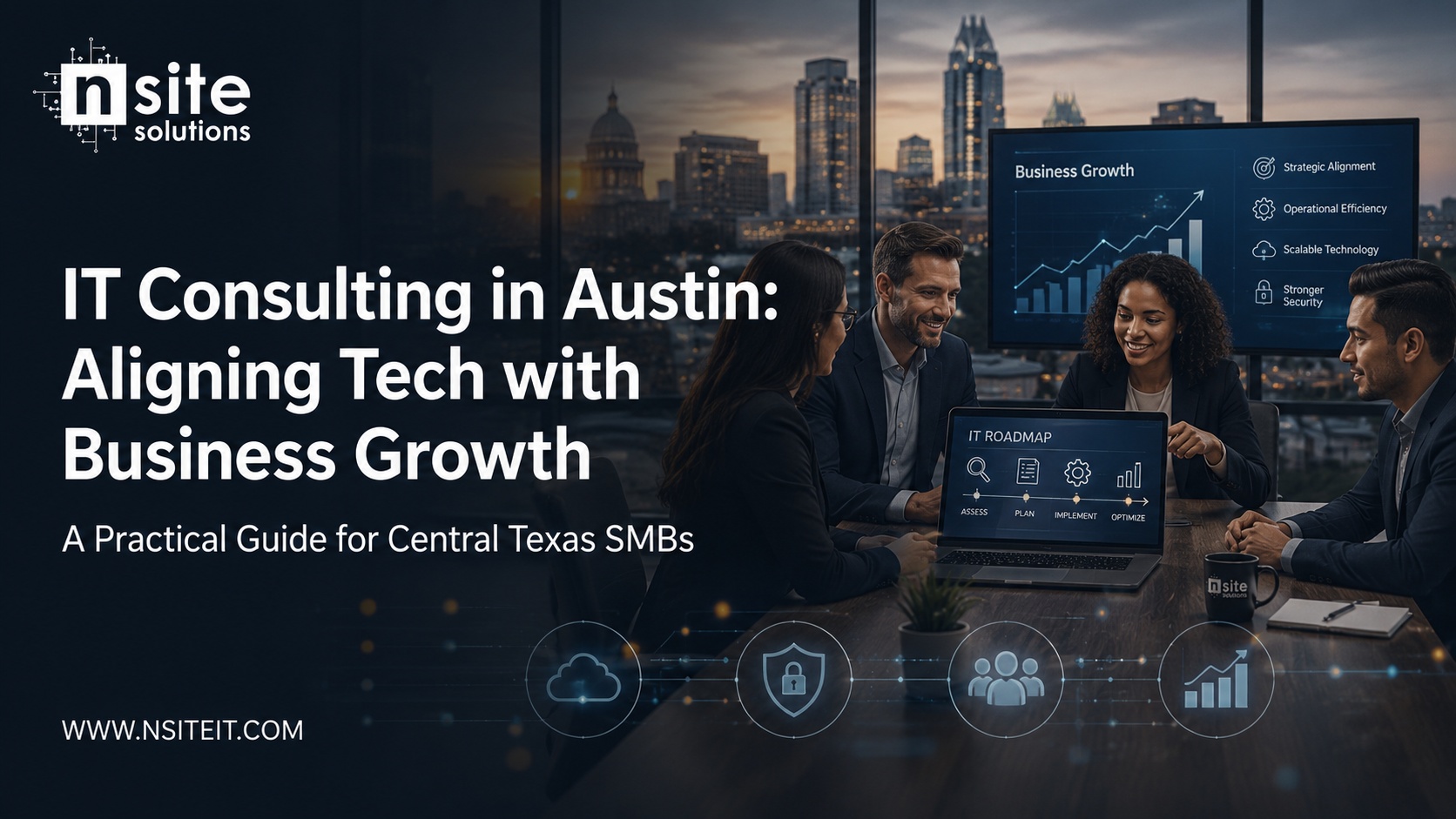
A practical guide for Central Texas SMBs that need less downtime, stronger security, and a clearer IT roadmap.
For many growing companies, technology starts as a set of quick fixes: a laptop here, a cloud app there, a firewall nobody has reviewed in years. That can work for a while. But once your team reaches 20, 30, or 50 employees, scattered IT decisions begin to slow the business down.
An IT consulting firm that Austin businesses can trust should do more than recommend tools. It should connect every technology decision to a business outcome, such as fewer disruptions, safer data, better collaboration, and more predictable growth. The goal is not to buy more technology. The goal is to make the technology you already depend on work harder for your business.
Why IT Strategy Matters More in Austin
Austin is still one of the country’s most tech-driven business markets, but the growth story has become more complex, which makes IT planning even more important for small and mid-sized businesses. The Austin region ended 2023 with nearly 203,000 tech-industry workers, the highest level ever reported, and the Dallas Fed reports that from December 2019 through December 2024, Austin-area employment in professional, scientific, and technical services grew 35.5%, while information services payrolls grew 20.3%.
At the same time, small businesses are investing more in technology, not less. GTIA’s 2025 SMB Technology and Buying Trends research found that 40% of SMBs increased their 2025 tech budgets over 2024, and 62% increased AI spending. For Austin-area businesses, the takeaway is clear: technology decisions are now business decisions. Without a clear IT strategy, new tools can create more cost, risk, and complexity. With the right plan, IT can support growth, security, productivity, and smarter day-to-day decisions.
Even companies that are not “tech companies” now depend on technology every day. Your phones, email, customer records, payment tools, cloud files, remote access, and line-of-business applications all affect how your team serves customers. If those systems are slow, disconnected, or poorly secured, growth becomes harder than it needs to be.
A good Austin IT consultant helps you step back and ask the right questions: What are we trying to accomplish this year? What systems are holding us back? Where are we exposed? Which investments will actually improve productivity, reduce risk, or support hiring?
Start with Business Goals, Then Build the IT Roadmap
The strongest IT strategy starts with business goals, not hardware. Before recommending a migration, a server upgrade, a security tool, or a support plan, your consultant should understand where your company is headed.
For most Central Texas SMBs, the roadmap should focus on four priorities:
- Uptime: keeping people productive and reducing recurring disruptions.
- Security: protecting business data, customer information, and employee access.
- Scalability: making it easier to add users, locations, tools, and remote workers.
- Predictable cost: reducing surprise expenses and planning IT investments clearly.
This is where professional IT Consulting Services can be valuable. The right partner can review your current environment, identify high-risk gaps, prioritize the work, and help you avoid unnecessary expenses from poorly planned projects.
Where IT Consulting Creates Practical ROI
Managed IT Services and Help Desk Support
When your team depends on email, cloud apps, phones, and shared files, “call someone when it breaks” is not a growth strategy. A managed IT model provides your business with proactive monitoring, patching, help desk support, and regular reviews, so small issues are handled before they become costly interruptions.
That is especially helpful for businesses without a full internal IT department. A related Nsite guide on Managed IT Services in Austin explains that managed support can give small businesses a practical middle ground: expert support, predictable monthly costs, and planning help without hiring several full-time roles.
Cybersecurity And Compliance Planning
Cybersecurity should be part of the roadmap from the beginning, not something added after a scare. CISA warns that cyber incidents have surged among small businesses that often lack the resources to defend against ransomware and other attacks. IBM’s 2025 Cost of a Data Breach Report also puts the global average breach cost at $4.4 million, which is a reminder that cyber risk has real business consequences.
For most SMBs, the first priority is practical protection: multi-factor authentication, secure access, endpoint protection, backup testing, employee awareness, and vendor oversight. Nsite’s IT Security Services are built around that layered approach, including security consulting, backup continuity, network security assessment, secure access, and proactive monitoring.
Cloud Services and Collaboration
Cloud tools can help a growing team work from anywhere, but only when they are configured and managed correctly. The U.S. Small Business Administration notes that cloud service providers and SaaS tools for email and workplace productivity can add security value, especially in hybrid work environments. That benefit depends on the right permissions, access controls, backup approach, and user training.
For businesses still relying on aging servers or disconnected apps, Cloud Services can help modernize collaboration, improve mobility, and reduce the burden of maintaining outdated infrastructure. The key is not moving everything at once. It is building a phased migration plan that protects daily operations while improving the systems your team uses most.
Data, Workflow, and Application Alignment
Growth also exposes workflow problems. Maybe sales data lives in one system, billing in another, and project updates in a spreadsheet only one person understands. Those gaps waste time and increase the chance of mistakes.
An IT consultant can help map where data moves, where work gets stuck, and which tools should be connected or replaced. Sometimes the fix is a simple configuration change. Sometimes it is an integration, a reporting dashboard, or a line-of-business application upgrade. The best recommendation is the one that solves a real business problem, not the one that adds another tool to manage.
What to Look for in an Austin IT Consulting Partner
A strong consulting partner should be able to explain complex technology in plain English. If you need a dictionary to understand the proposal, that is a warning sign. You should expect clear recommendations, a transparent scope, and practical next steps.
Before you choose an Austin IT consulting partner, ask:
- What risks would you address first, and why?
- How will you document our environment?
- What should be handled as ongoing support versus a one-time project?
- How do you approach cybersecurity and backup testing?
- What can wait, and what should not wait?
- How will you keep our IT plan aligned with our business goals?
You should also look for a partner who understands SMB realities. Smaller businesses need enterprise-level thinking, but they also need right-sized solutions, clear pricing, and a team that respects their budget.
Turn IT From a Headache into a Growth Advantage
The right IT roadmap should make day-to-day operations easier while giving leadership more confidence about the future. That does not happen by chasing every new platform or trend. It happens when your technology decisions are tied to measurable business priorities.
Start with the biggest friction points: recurring downtime, weak security, aging hardware, disconnected systems, or slow support. Then turn those issues into a prioritized plan. Some fixes may be urgent. Others can be staged over the next quarter or year. A clear roadmap helps you invest in the right order and avoid spending money on tools your team will not fully use.
NIST’s Small Business Cybersecurity Corner is a useful reminder that SMBs need practical, current resources, not generic advice. The same is true for every part of IT consulting. Your plan should fit your company, your team, and the way you actually work.
Build a Smarter IT Roadmap
IT consulting in Austin should help your business move from reactive technology decisions to a practical growth plan. With the right guidance, IT becomes less of a headache and more of a foundation for productivity, security, and scale.
If you are ready to review your current systems, identify risks, and build a roadmap that supports your next stage of growth, contact Nsite Solutions. We will help you understand what is working, what needs attention, and what a right-sized IT plan could look like for your business.
FAQ’s About IT Consulting in Austin
What Does an IT Consultant Do for a Small Business In Austin?
An IT consultant helps a small business evaluate its current technology, identify risks, and create a practical roadmap for improvement. In Austin, that often includes planning for cloud tools, cybersecurity, help desk support, hardware upgrades, and scalable systems as the company grows.
How is IT Consulting Different from Managed IT Services?
IT consulting focuses on strategy, planning, projects, and technology decisions. Managed IT services focus on ongoing support, monitoring, maintenance, and help desk coverage. Many growing businesses need both: consulting to set the roadmap and managed services to keep systems running.
When Should a Small Business Hire an IT Consultant?
A small business should consider IT consulting when recurring tech issues, cybersecurity concerns, growth plans, or outdated systems begin to affect productivity. It is also smart to bring in a consultant before major changes, such as moving to the cloud, opening a new location, or replacing key software.
What Should Be Included in an IT Roadmap?
An IT roadmap should include current risks, priority fixes, budget estimates, timelines, security improvements, cloud or infrastructure plans, and support needs. It should also connect each recommendation to a business goal, such as reducing downtime, improving data protection, or supporting hiring.
Can IT Consulting Help With Cybersecurity?
Yes. IT consulting can help identify cybersecurity gaps and prioritize practical improvements like MFA, secure access, endpoint protection, backup testing, employee training, and vendor management. The goal is to reduce risk in a way that fits the business’s size and budget.
How Do I Choose the Right IT Consulting Partner in Austin?
Look for a partner that explains recommendations clearly, understands small-business needs, offers local support, and connects technology decisions to business outcomes. Ask about documentation, response expectations, security planning, project scope, and how often they will review your roadmap.